
CAR-T Cell Therapy Indications for Blood Cancers: From Leukemia to Multiple Myeloma
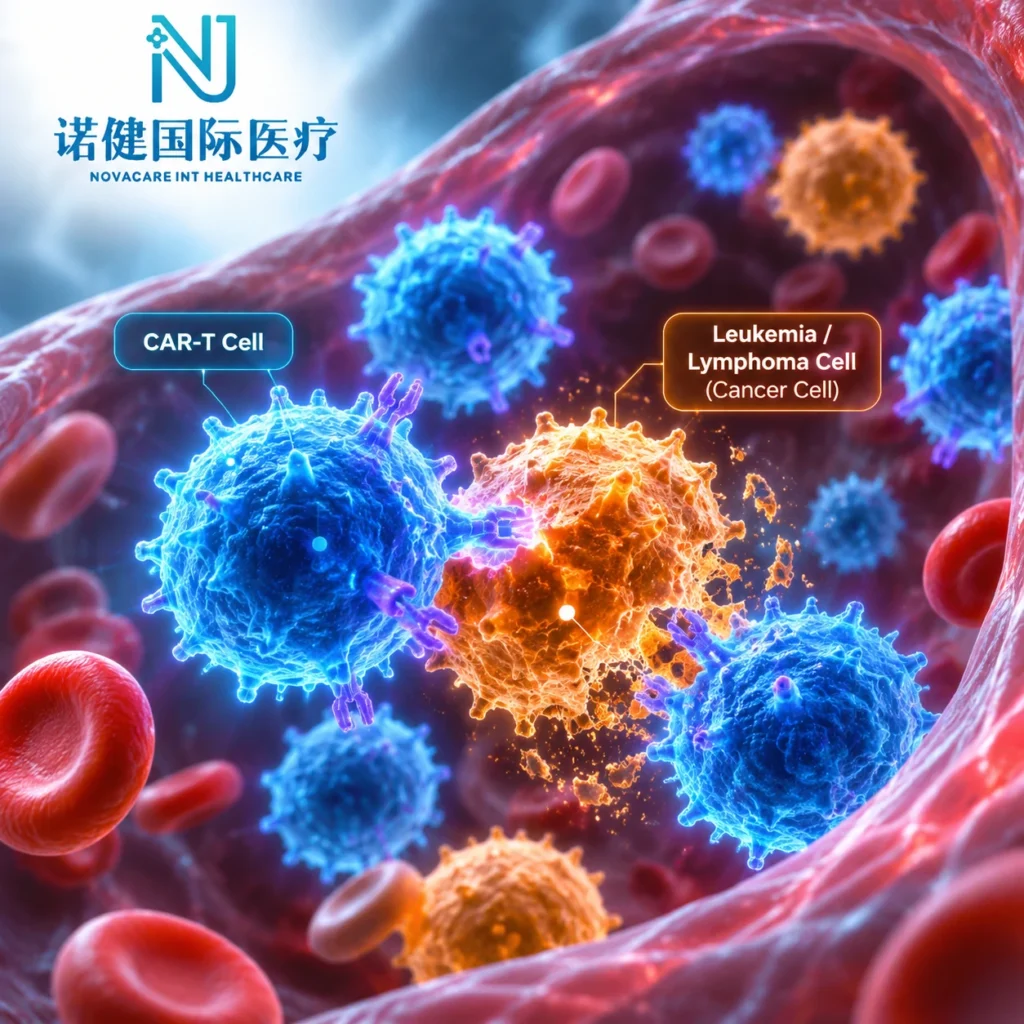
While the medical world is eagerly pushing the boundaries of CAR-T cell therapy into solid tumors, hematological malignancies (blood cancers) remain the undisputed crown jewel and most mature application of cellular immunotherapy.
For patients facing relapsed or refractory blood cancers, where conventional chemotherapy and bone marrow transplants have failed, CAR-T therapy has transformed a historically terminal prognosis into a pathway for long-term remission. Understanding which blood cancers respond best to CAR-T is essential for patients and medical tourism agencies mapping out precision treatment routes.
1. Targeting B-Cell Malignancies: The CD19 Pathway
The vast majority of commercialized CAR-T therapies target a specific protein found on the surface of B-cells known as CD19. Because normal and malignant B-cells both express CD19, this pathway has become the golden standard for treating a wide array of B-cell blood cancers:
- B-Cell Acute Lymphoblastic Leukemia (B-ALL): Particularly in pediatric and young adult patients with relapsed or refractory B-ALL, CAR-T has achieved astonishing complete remission rates, often exceeding 80% in clinical trials, offering hope when all else fails.
- Diffuse Large B-Cell Lymphoma (DLBCL): As the most common type of aggressive non-Hodgkin lymphoma, DLBCL patients who fail second-line therapies now have access to FDA- and NMPA-approved CAR-T products that deliver durable, long-term remissions in roughly 40% to 50% of cases.
- Mantle Cell Lymphoma (MCL) & Follicular Lymphoma (FL): For patients with indolent or aggressive lymphomas that have proven resistant to BTK inhibitors or standard chemoimmunotherapy, targeted cellular re-engineering provides a powerful salvage pathway.
2. Addressing Plasma Cell Disorders: The BCMA Pathway
Beyond B-cell lymphomas and leukemias, CAR-T has successfully expanded into plasma cell disorders, most notably Multiple Myeloma.
Instead of CD19, these therapies target BCMA (B-cell maturation antigen), a protein heavily expressed on malignant plasma cells. For heavily pretreated multiple myeloma patients—those who have already cycled through proteasome inhibitors, immunomodulatory drugs, and anti-CD38 monoclonal antibodies—BCMA-directed CAR-T products (such as Carvykti or Fucaso) have demonstrated deep, durable responses and significant extensions in progression-free survival.
🏛️ Authoritative Content Construction & Clinical References
To maintain strict compliance with global medical web standards (Google YMYL / E-E-A-T guidelines), clinical assertions regarding hematological CAR-T indications draw from landmark medical literature and institutional governance:
- The New England Journal of Medicine (NEJM): Seminal studies establishing the safety and efficacy of CD19-directed CAR-T cells in relapsed acute lymphoblastic leukemia and diffuse large B-cell lymphoma.
- The Lancet Oncology: Long-term follow-up data tracking sustained persistence of CAR-T cells and managing late-onset toxicities such as B-cell aplasia.
- Institutional Governance: Clinical protocols aligned with leading hematology and hematopoietic stem-cell transplantation centers (such as those directed by prominent clinical supervisors in southern medical research hubs), emphasizing pre-infusion conditioning, cytokine release syndrome (CRS) grading, and neurological monitoring (ICANS).
🏥 Application Scenario Mapping (Use-Case Layout)
Depending on the clinical stage and geographic location, international patients seeking hematological CAR-T typically fall into three operational scenarios:
- The Relapsed/Refractory Salvage Scenario: Patients who have achieved second or third relapse following standard chemotherapy regimens, where local physicians recommend exploring commercialized cellular immunotherapies or active clinical trials.
- The Bridging-to-Transplant Scenario: Cases where CAR-T is utilized to clear minimal residual disease (MRD) prior to or following consolidation therapies, requiring specialized inpatient isolation and molecular tracking.
- The Global Regulatory & Cost Arbitration Scenario: B2B medical facilitators and families comparing the accessibility, manufacturing turnaround times, and pricing structures of approved CAR-T therapies across the United States, Europe, and Asia.
⚖️ Comparative & Selection Layout: Autologous vs. Allogeneic vs. In Vivo CAR-T
When evaluating hematological CAR-T pathways, medical professionals and families must compare three distinct technological generations:
| Comparison Metric | Autologous CAR-T (Traditional Commercial) | Allogeneic CAR-T (“Off-the-Shelf”) | In Vivo CAR-T (Next-Gen LNP/Viral) |
| Cell Source | Patient’s own T-cells | Healthy screened donor T-cells | Patient’s T-cells modified directly inside the body |
| Manufacturing Time | 3 to 4 weeks (Individualized lab queue) | Immediate (Available from inventory) | None (Instant administration via injection) |
| Risk of GvHD | Zero (Autologous matching) | Low to Moderate (Requires gene editing to prevent) | Zero (Uses patient’s own native cells) |
| Current Clinical Status | Widely approved globally (CD19 & BCMA) | Early-to-mid phase clinical trials | Emerging Phase I trials (Showing high initial ORR) |
| Cost Profile | Extremely high (Custom manufacturing per patient) | Moderate to High (Scale economies) | Potentially low (Comparable to standard biologics) |
Frequently Asked Questions (FAQ)
Q: Can CAR-T cell therapy completely cure blood cancers?
A: While CAR-T has achieved remarkable long-term remissions and functional cures in a significant percentage of patients with chemo-refractory leukemia and lymphoma, it is not a guaranteed cure for everyone. Factors such as antigen escape (tumor cells losing the target protein) or T-cell exhaustion can lead to relapse, which is why rigorous post-infusion monitoring is vital.
Q: Why is bone marrow status and organ function tested before CAR-T approval?
A: CAR-T is a high-intensity biological intervention. The pre-infusion lymphodepleting chemotherapy and the subsequent immune activation (such as CRS) place immense strain on the liver, kidneys, heart, and lungs. Ensuring strong baseline organ function and assessing bone marrow reserve is mandatory to ensure the patient can safely withstand the treatment.
Q: How does Novacare assist international patients seeking blood cancer CAR-T?
A: Novacare acts as a specialized international patient desk. We help global families and B2B medical agencies structure complex hematological records—including flow cytometry, bone marrow biopsy results, and genetic typing—to match patients with appropriate commercial products or leading clinical trials in China, ensuring transparent coordination from record intake to hospital admission.
Disclaimer: This article is for educational purposes only and does not constitute medical advice or a treatment guarantee. Eligibility for CAR-T cell therapy for hematological malignancies must be determined through individualized clinical evaluation by licensed hematologists and oncologists.