
CAR-T Cell Therapy for T-Cell Lymphoma and AML: Emerging Targets and Clinical Frontiers
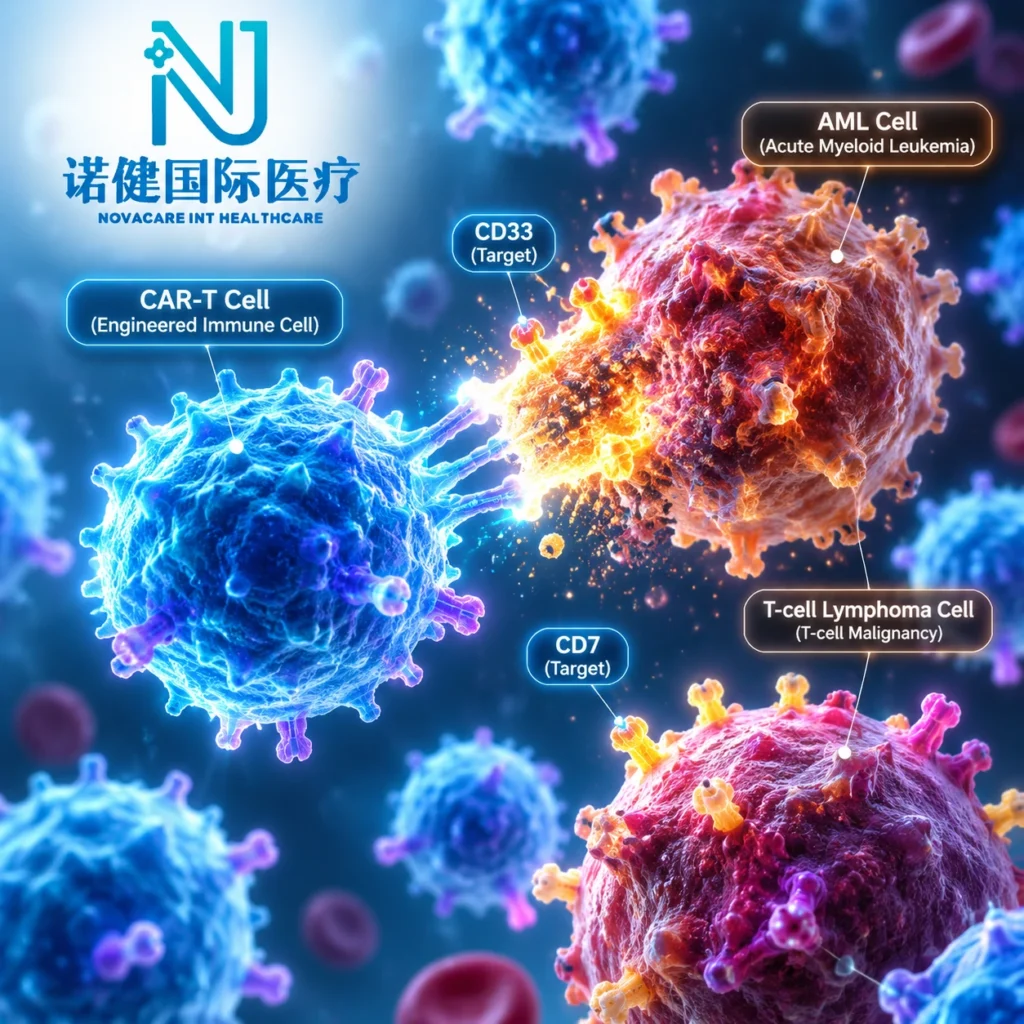
The monumental success of CD19 and BCMA-targeted CAR-T therapies has transformed the treatment landscape for B-cell malignancies and multiple myeloma. However, oncology’s battle against blood cancers is far from over.
When researchers turn their focus toward T-cell lymphomas and Acute Myeloid Leukemia (AML), they encounter a vastly more complex biological battlefield. Because these cancers originate from the very lineages that defense systems rely on, standard engineering approaches fail. Today, exploring novel targets like CD7, CD123, and CLL-1 defines the bleeding edge of clinical research.
1. The Challenge of T-cell Malignancies: The “Fratricide” Problem
Developing CAR-T cell therapy for T-cell acute lymphoblastic leukemia (T-ALL) or peripheral T-cell lymphoma (PTCL) introduces a profound bio-engineering dilemma known as fratricide (self-annihilation).
Because CAR-T cells are, by definition, engineered T-cells, and T-cell malignancies express the exact same surface markers as healthy T-cells (such as CD7), the newly minted CAR-T cells will immediately recognize, attack, and destroy each other during the laboratory manufacturing phase. To overcome this, scientists utilize advanced gene-editing tools (like CRISPR-Cas9) to manually “knock out” the target antigen from the therapeutic T-cells before they are infused into the patient.
2. Tackling Acute Myeloid Leukemia (AML): CD123, CLL-1, and CD33
Acute Myeloid Leukemia is notoriously aggressive, with limited salvage options when initial treatments fail. Unlike B-ALL, AML lacks a uniform, clean biomarker equivalent to CD19.
- The Target Dilemma: Markers like CD123 and CLL-1 are frequently overexpressed on leukemic stem cells (LSCs). However, they are also expressed at lower levels on normal, healthy hematopoietic stem cells.
- On-Target, Off-Tumor Toxicity: A major hurdle in AML CAR-T clinical trials is severe, prolonged bone marrow suppression. Attacking CD123 or CD33 can inadvertently wipe out normal blood cell production, making strategic dual-targeting (such as sequential CD123/CLL-1 infusions) or safety-switch integrations critical areas of ongoing Phase I/II research.
🏛️ Authoritative Content Construction & Clinical References
To align with stringent medical web governance (Google E-E-A-T / YMYL standards), clinical insights regarding emerging hematological targets derive from peer-reviewed oncology discourse:
- Blood (The Journal of the American Society of Hematology): Pioneering pilot trial data evaluating novel receptor modifications and dual-target strategies in refractory acute myeloid leukemia.
- ClinicalTrials.gov & Institutional Registries: Ongoing phase 1/2 trial tracking for multi-CAR T-cell therapies targeting CD7-positive T-cell malignancies and cooperative academic studies across major hematology hospital networks.
- Cellular Immunotherapy Consensus: Expert guidelines on navigating “fratricide” management via gene-edited autologous platforms and the clinical necessity of bridging to allogeneic stem-cell transplantation.
🏥 Application Scenario Mapping (Use-Case Layout)
For international patients and medical tourism facilitators, exploring T-cell lymphoma or AML trials maps into three distinct operational scenarios:
- The Ultra-Refractory Salvage Scenario: Patients with relapsed or refractory AML or T-cell lymphoma who have exhausted all NMPA- or FDA-approved commercial drugs and require access to pioneering Phase I clinical trials.
- The Bridging-to-Allo-HSCT Scenario: Utilizing innovative CD7 or CD123 CAR-T regimens as a temporary or debulking measure to achieve minimal residual disease (MRD) negativity, successfully setting the patient up for a subsequent allogeneic stem cell transplant.
- The Global Protocol Benchmarking Scenario: Medical agencies evaluating specialized academic medical centers in Asia and Europe that offer cutting-edge multi-target cellular platforms unavailable in standard community hospital settings.
⚖️ Comparative & Selection Layout: Standard Commercial CAR-T vs. Emerging Clinical Trials
When patients face aggressive blood cancers like AML or T-cell lymphoma, they must understand the fundamental differences between standard commercial products and emerging exploratory trials:
| Comparison Metric | Standard Commercial CAR-T (CD19 / BCMA) | Emerging Clinical Trials (CD7, CD123, CLL-1) |
| Disease Application | B-cell lymphomas, B-ALL, Multiple Myeloma | T-cell malignancies, Acute Myeloid Leukemia (AML) |
| Regulatory Status | Fully approved by FDA / NMPA | Investigational (Phase I / II Clinical Trials) |
| Target Specificity | High (Clear distinction from essential tissues) | Complex (Requires gene editing to prevent fratricide or manage bone marrow toxicity) |
| Access Mechanism | Commercial prescription / Hospital pharmacy network | Strict institutional ethics committee approval & strict clinical trial inclusion criteria |
| Primary Clinical Goal | Durable long-term remission / functional cure | Disease control, safety profiling, and bridging to transplant |
Frequently Asked Questions (FAQ)
Q: Why are T-cell lymphoma and AML harder to treat with CAR-T than B-cell cancers?
A: The primary difficulty lies in target specificity. In B-cell cancers, destroying all B-cells is manageable because the body can survive with immunoglobulin replacement therapy. In T-cell cancers or AML, the target markers overlap with healthy T-cells or vital hematopoietic stem cells, risking severe immune deficiency or profound, life-threatening bone marrow suppression unless advanced gene-editing techniques are utilized.
Q: Are these emerging CAR-T trials available commercially?
A: No. Treatments targeting CD7, CD123, or CLL-1 are strictly investigational. They are only accessible by qualifying for active, IRB-approved clinical trials at specialized medical research centers. Patients must meet precise inclusion criteria regarding organ function, disease burden, and prior therapies.
Q: How does Novacare assist patients looking for cutting-edge hematology trials?
A: Novacare bridges the gap between international patients and leading academic clinical trial centers. We perform meticulous medical record intake, evaluate whether a patient’s genetic and phenotypic profile matches active trial criteria, and coordinate safe, transparent cross-border medical consultations.
Disclaimer: This article is for educational and informational purposes only and does not constitute medical advice or a treatment guarantee. Access to emerging clinical trials requires strict eligibility verification, ethical committee approval, and evaluation by licensed hematology specialists.