What is the Claudin18.2 Target? New Hope with Gastric Cancer CAR-T Cell Therapy
Treating advanced gastric (stomach) cancer has historically been one of the most difficult challenges in oncology. When traditional chemotherapy reaches its maximum efficacy, patients often run out of options. For a long time, the only major targeted therapy for gastric cancer revolved around the HER2 protein—but this only applies to a small fraction of patients.
Today, a massive breakthrough has emerged in precision oncology: the Claudin18.2 (CLDN18.2) target. This discovery has not only created new targeted drug pathways but has also served as the key to unlocking the world’s first approved CAR-T cell therapy for solid tumors.
1. What is the Claudin18.2 (CLDN18.2) Target?
Claudins are a family of proteins responsible for maintaining “tight junctions” between cells—essentially acting like the mortar between the bricks of your body’s tissues, preventing fluid from leaking out.
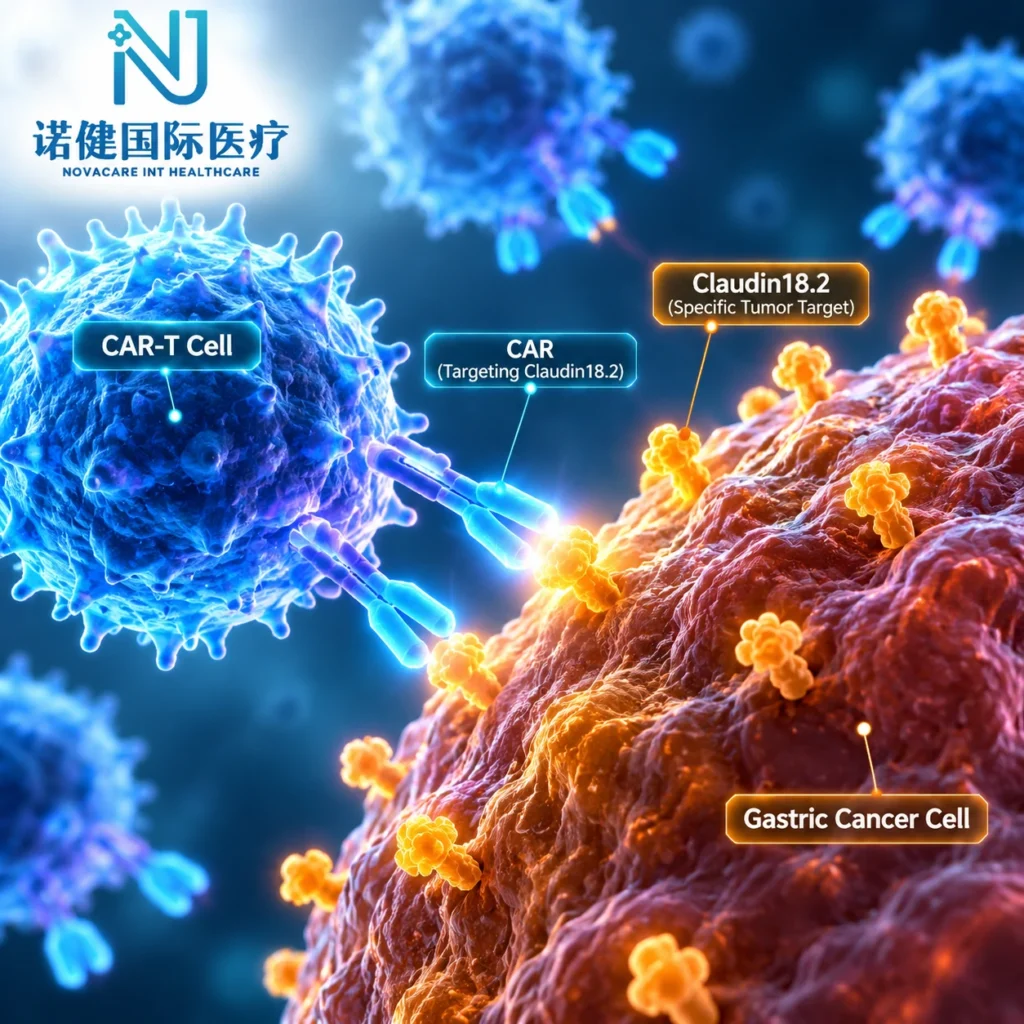
CLDN18.2 is a highly specific member of this family. In a healthy human body, it is found almost exclusively buried deep within the lining of the stomach. Because it is hidden tightly between the cells, the immune system and circulating drugs cannot reach it.
However, when normal stomach cells mutate into gastric cancer, the structural integrity of the tissue breaks down. The tight junctions fall apart, and the CLDN18.2 proteins are suddenly highly exposed on the surface of the cancer cells. This makes CLDN18.2 a perfect “bullseye.” A therapy designed to attack CLDN18.2 will aggressively hunt down the exposed gastric cancer cells while completely ignoring the healthy tissues where the protein remains safely hidden.
2. The Importance of Testing: Are You CLDN18.2 Positive?
Not every gastric cancer patient expresses this target. To determine eligibility for these advanced therapies, oncologists must perform an Immunohistochemistry (IHC) test on a sample of the patient’s tumor biopsy.
Precision oncology protocols specifically look for patients who are CLDN18.2 Positive and typically HER2 Negative. If your pathology report confirms this profile, you may be a candidate for next-generation clinical pathways.
3. The Global Breakthrough: Solid Tumor CAR-T Cell Therapy
For the past decade, CAR-T cell therapy has been famous for curing blood cancers (like leukemia and lymphoma). However, solid tumors (like gastric, lung, and liver cancers) were deemed too difficult to treat because their dense microenvironments physically blocked immune cells from entering.
This barrier was officially broken in China with the clinical development and approval of therapies like Satri-cel. By utilizing the highly specific Claudin18.2 target, researchers successfully engineered CAR-T cells capable of navigating to the stomach, penetrating the solid tumor microenvironment, and launching a lethal immune response against the advanced gastric cancer cells. This marks the first time in global medical history that CAR-T therapy has been officially approved and utilized for solid gastrointestinal tumors.
4. How Does Claudin18.2 CAR-T Work in the Body?
The process is a masterpiece of personalized cellular engineering:
- Extraction: A patient’s own T-cells (immune cells) are extracted from their blood.
- Reprogramming: In a highly specialized laboratory, scientists insert a specific gene into the T-cells, equipping them with a Chimeric Antigen Receptor (CAR)—essentially a GPS radar designed exclusively to lock onto the Claudin18.2 protein.
- Expansion and Reinfusion: The engineered cells are multiplied into the billions and infused back into the patient, where they actively hunt and destroy the CLDN18.2-positive cancer cells.
5. Clinical Safety and Managing Expectations
While groundbreaking, Claudin18.2 CAR-T cell therapy is an intense medical procedure, not a magic pill. It is currently reserved for patients who have already failed at least two prior lines of systemic therapy. Furthermore, as the billions of CAR-T cells attack the tumor, patients can experience severe inflammatory responses, such as Cytokine Release Syndrome (CRS). Therefore, the treatment can only be administered in top-tier medical centers equipped with specialized ICUs and experienced immunology teams.
6. Accessing Advanced CAR-T Pathways with Novacare
Because China is currently leading the global clinical translation and commercialization of solid tumor CAR-T therapies, international patients are increasingly looking toward Chinese oncology centers for life-saving access at a fraction of the cost typically seen in Western healthcare systems.
Novacare serves as the professional international medical desk facilitating this access. We assist global medical tourism agencies and international patients by organizing complex medical records, translating IHC pathology reports, and facilitating direct clinical reviews with leading cellular therapy experts in China.
- For Medical Agencies & Partners: Integrate the world’s most advanced solid tumor CAR-T pathways into your B2B medical tourism portfolio. Novacare provides secure, transparent clinical coordination.
- For Patients and Families: If you have advanced gastric cancer, check your pathology report. Contact the Novacare patient desk today to submit your CLDN18.2 status for a structured CAR-T feasibility review.
Frequently Asked Questions (FAQ)
Q: Can Claudin18.2 CAR-T therapy be used for other types of cancer?
A: While it is currently approved specifically for advanced gastric cancer and gastroesophageal junction adenocarcinoma, clinical trials are actively exploring its efficacy in other CLDN18.2-positive solid tumors, such as certain types of pancreatic cancer.
Q: How do I get tested for Claudin18.2?
A: You do not need a new surgery. If you have already had a biopsy or tumor removal surgery, the hospital laboratory still has your tumor tissue safely stored in paraffin blocks. You simply need to request that your oncologist or pathologist perform an “Immunohistochemistry (IHC) test for CLDN18.2” on your existing tissue sample.
Q: What if I am HER2 positive?
A: If your tumor is HER2 positive, your primary targeted pathway will likely involve HER2-directed therapies (like Trastuzumab) or HER2-targeted Antibody-Drug Conjugates (ADCs). Claudin18.2 CAR-T is generally indicated for patients whose tumors are HER2 negative and have failed other standard treatments.
Disclaimer: This article is for educational purposes only and does not constitute medical advice or a treatment guarantee. Eligibility for Claudin18.2 CAR-T cell therapy requires stringent clinical evaluation, biomarker confirmation, and review by licensed oncology specialists.