
Proton Therapy vs Traditional Radiation: Why It Is Safer for Pediatric and Skull-Base Tumors
Radiation therapy is one of the three foundational pillars of cancer treatment. However, when a tumor is located in an extremely sensitive anatomical area—such as deep inside the brain or wrapped around the spine—or when the patient is a young child, traditional radiation presents a terrifying dilemma. The collateral damage caused by the radiation can sometimes be as devastating as the cancer itself.
To solve this, modern precision oncology utilizes Proton Therapy. Representing the pinnacle of radiotherapeutic technology, proton therapy fundamentally changes the laws of physics inside the patient’s body, offering unprecedented protection for critical organs and developing nervous systems.
1. The Physics of Proton Therapy: Understanding the “Bragg Peak”
To understand why proton therapy is superior for complex cases, we must look at how it delivers energy.
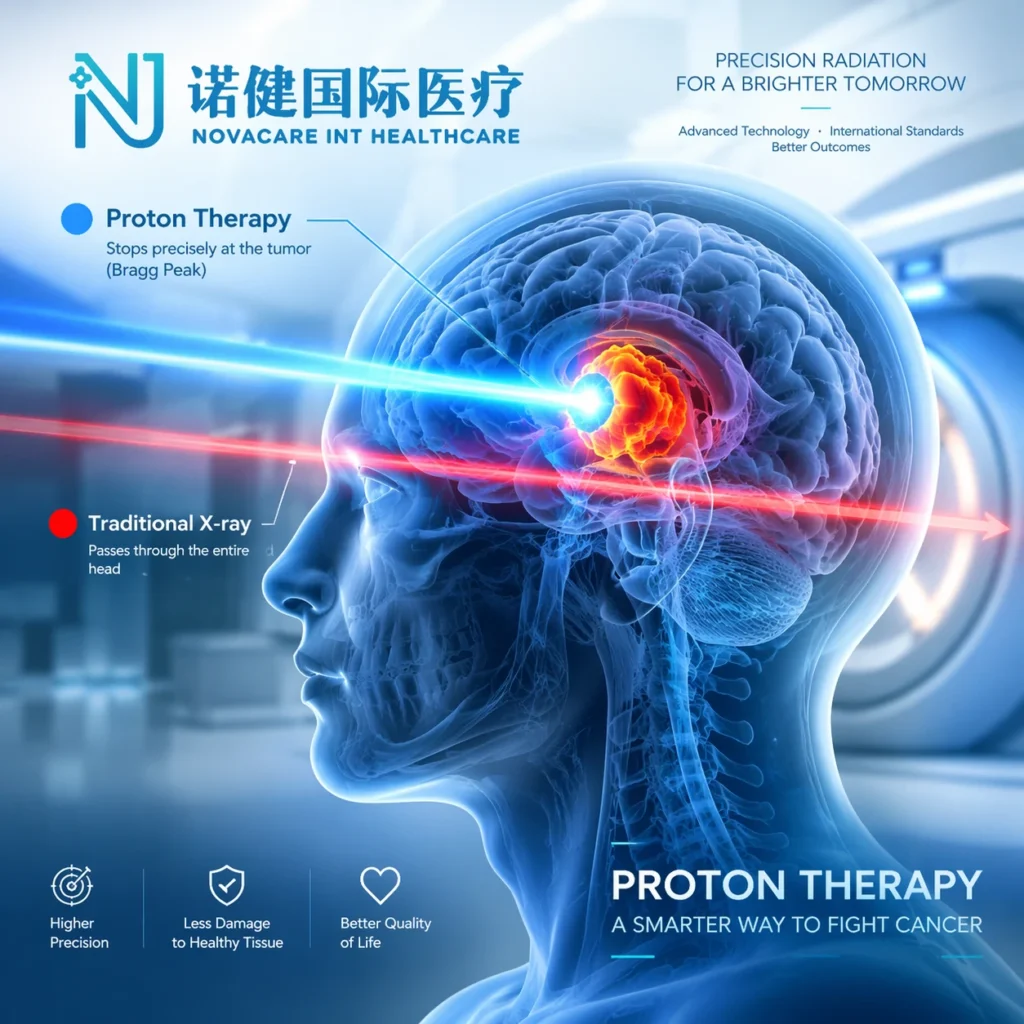
Proton therapy accelerates positively charged subatomic particles (protons) to roughly two-thirds the speed of light. As these protons enter the human body, they release a very low dose of radiation. However, right as they reach their designated target depth (the tumor), they rapidly release 100% of their destructive energy in a sudden burst. This phenomenon is known in physics as the “Bragg Peak.”
Immediately after this peak, the radiation dose drops to absolute zero. There is no radiation traveling beyond the tumor.
2. Proton Therapy vs. Traditional Radiation (EBRT): What is the Difference?
The difference lies in the “Exit Dose.”
- Traditional Radiation (X-rays/Photons): X-rays act like an armor-piercing bullet. They deliver radiation as they enter the body, hit the tumor, and continue to deliver radiation as they exit out the other side of the body. This “exit dose” indiscriminately damages the healthy tissues and organs situated behind the tumor.
- Proton Therapy: Protons act like a depth charge. Because of the Bragg Peak, doctors can program the protons to travel exactly 10 centimeters deep, detonate their cancer-killing energy, and stop completely. There is zero exit dose, shielding the healthy organs resting just millimeters behind the cancer.
3. Why Proton Therapy is the Gold Standard for Pediatric Tumors
Children are not just miniature adults. Their rapidly dividing cells, growing bones, and developing neurological systems are exquisitely sensitive to radiation.
When traditional radiation is used on a child, the collateral damage can lead to severe, lifelong consequences, including stunted bone growth, hormonal deficiencies, and significant drops in IQ and cognitive function. Furthermore, the stray radiation dramatically increases the risk of the child developing a “secondary primary cancer” decades later.
Because proton therapy eliminates the exit dose, it drastically reduces the volume of healthy tissue exposed to radiation. This preserves a child’s cognitive development, protects their endocrine system, and minimizes the risk of radiation-induced secondary cancers, allowing them to grow up and live a normal, healthy life.
4. Protecting Critical Structures: Skull-Base and Spine Tumors
In adults, proton therapy is highly sought after for tumors located in the “no-go zones” of the human body, specifically the skull base and the spine (such as chordomas, chondrosarcomas, and meningiomas).
These tumors often grow tightly pressed against the optic nerve, the brainstem, or the spinal cord. If traditional radiation is used to deliver a lethal dose to the tumor, the spillover radiation could easily cause permanent blindness, paralysis, or brainstem damage. Proton therapy allows oncologists to deliver a massive, curative dose of radiation to the tumor while ensuring the optic nerve and spinal cord—located just a millimeter away—remain completely untouched and safe.
5. Precision Radiotherapy Referral with Novacare
Proton therapy requires massive, highly sophisticated cyclotrons and incredibly specialized medical teams. Consequently, true proton therapy centers are exceedingly rare, and accessing them can be logistically complex for international patients.
Novacare functions as a professional international patient service desk, bridging the gap between global patients and top-tier proton therapy centers in China. We support medical tourism agencies and families by organizing the translation of complex DICOM imaging, facilitating remote multidisciplinary tumor board (MDT) reviews, and arranging seamless medical travel itineraries.
- For Medical Agencies & Partners: Elevate your inbound medical portfolio by offering your clients reliable access to one of the world’s most advanced precision oncology treatments.
- For Patients and Families: If you or your child are facing a complex tumor diagnosis, contact the Novacare patient desk. Submit your medical records to explore whether the Bragg Peak advantage of proton therapy is the right clinical route for you.
Frequently Asked Questions (FAQ)
Q: Is proton therapy effective for all types of cancer?
A: While proton therapy is a powerful tool, it is not necessary or suitable for every type of cancer. It is most beneficial for solid tumors that have not spread (metastasized) to other parts of the body, particularly those located near critical organs (brain, spine, eyes, head and neck, and left-sided breast cancer) and for pediatric cancers.
Q: Does receiving proton therapy hurt?
A: No. The actual delivery of the proton beam is completely painless, much like having a standard X-ray or CT scan taken. You will not feel the radiation entering your body. The treatment sessions are typically done on an outpatient basis and take only a few minutes, though positioning the patient perfectly can take longer.
Q: Why is proton therapy more expensive than traditional radiation?
A: The cost is driven by the technology. A proton therapy center requires a particle accelerator (cyclotron) that weighs hundreds of tons, massive magnetic gantries to steer the beam, and specialized building infrastructure to house the equipment. This massive capital investment makes proton therapy more expensive and less widely available than standard X-ray radiation machines.
Disclaimer: This article is for educational purposes only and does not constitute medical advice or a treatment guarantee. Eligibility for Proton Therapy depends entirely on individual clinical evaluation, tumor location, and review by licensed radiation oncology specialists.