Iodine-125 Seed Brachytherapy: How Internal Radiation Targets Tumors
Traditional External Beam Radiation Therapy (EBRT) is a cornerstone of modern oncology, but it comes with significant physical limitations. To reach a deep-seated tumor, the radiation beams must penetrate healthy skin, muscles, and adjacent organs.
This presents a massive clinical challenge when a tumor recurs in the exact same location after a patient has already received a full course of external radiation. Because the surrounding healthy tissues have already absorbed their maximum lifetime tolerance of radiation, applying another external beam would cause catastrophic damage. To solve this dilemma, oncologists turn to a highly advanced form of localized treatment: Iodine-125 Seed Brachytherapy (Internal Radiation).
1. What is Iodine-125 Seed Brachytherapy?
Brachytherapy comes from the Greek word “brachys,” meaning short-distance. Instead of firing radiation from a machine outside the body, brachytherapy places the radioactive source directly inside the cancer.
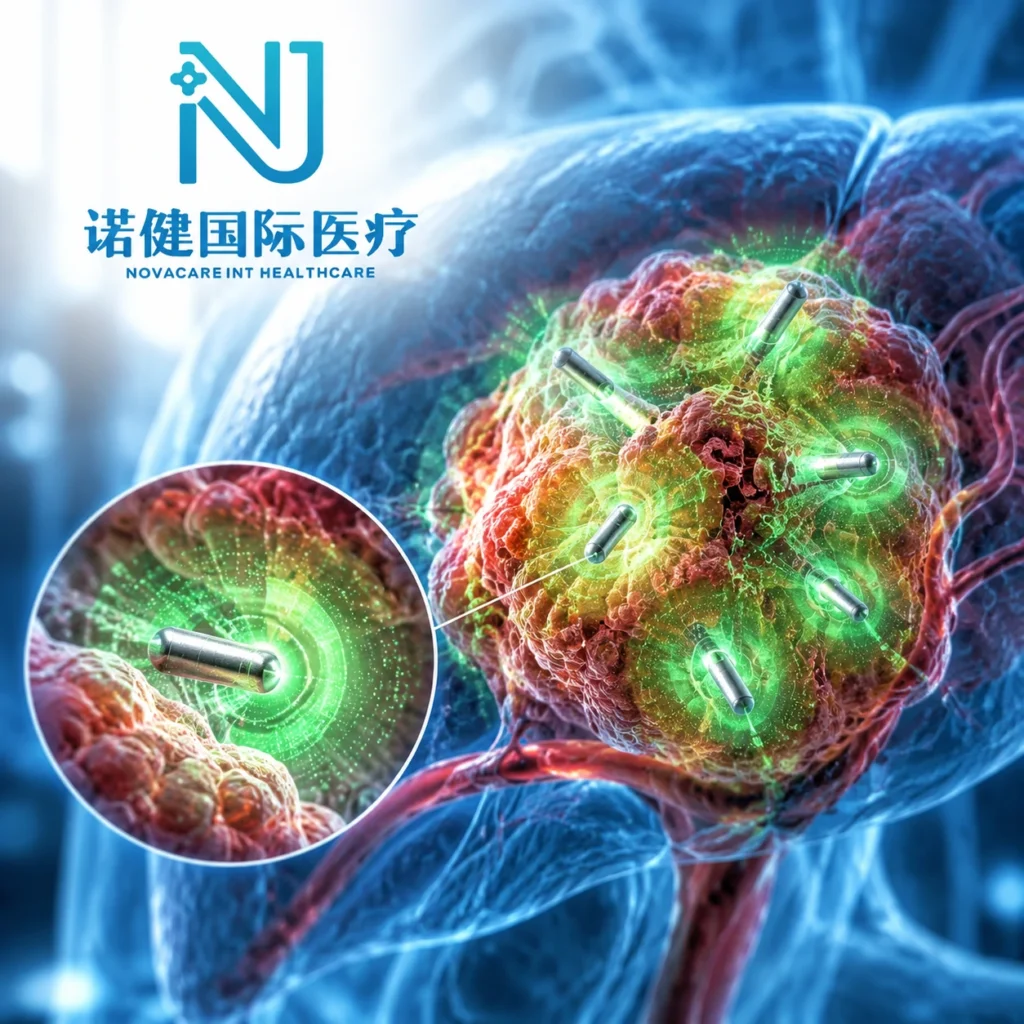
Iodine-125 (I-125) seeds are microscopic, laser-sealed titanium capsules, each roughly the size of a single sesame seed (about 4.5 mm long and 0.8 mm thick). Inside these tiny capsules resides the radioactive isotope Iodine-125. Functionally, doctors are implanting microscopic, highly targeted radioactive “bombs” directly into the tumor.
2. How It Works: Continuous, Targeted Internal Radiation
The procedure is a masterpiece of spatial geometry and medical imaging.
- Image-Guided Implantation: Using advanced 3D treatment planning software and real-time CT or ultrasound guidance, an interventional oncologist maps the exact size and shape of the tumor. Using specialized hollow needles, they implant dozens to over a hundred I-125 seeds uniformly throughout the tumor mass.
- Continuous Low-Energy Radiation: Once implanted, these seeds begin emitting low-dose gamma rays 24 hours a day, 7 days a week. Unlike external radiation, which is given in short bursts over several weeks, Iodine-125 seeds deliver continuous, relentless radiation that systematically destroys the DNA of the cancer cells. The isotope has a half-life of about 60 days, meaning it delivers its most powerful clinical effect over the first few months.
3. The Unique Advantage: The “Rapid Dose Fall-Off” Effect
The absolute greatest advantage of Iodine-125 seed brachytherapy is a physical principle known as “rapid dose fall-off.”
The radiation emitted by I-125 is highly concentrated but has a very short penetration range (typically only 1.5 to 1.7 centimeters). This means the core of the tumor receives a massive, lethal dose of radiation. However, just one or two centimeters outside the tumor’s edge, the radiation dose drops to nearly zero. This pinpoint accuracy allows doctors to safely destroy tumors located dangerously close to vital structures—such as major blood vessels, the spinal cord, or the bladder—without causing them harm.
4. Who is a Candidate for Iodine-125 Brachytherapy?
Because of its unique physical properties, Iodine-125 seed implantation is highly effective for specific clinical scenarios:
- Early-Stage Prostate Cancer: It is a gold-standard treatment that offers cure rates comparable to radical surgical removal, but with a significantly lower risk of causing incontinence or erectile dysfunction.
- Locally Recurrent Tumors: It is a vital lifeline for patients whose head and neck cancers, rectal cancers, or gynecological tumors have returned in previously irradiated areas where surgery or further external radiation is impossible.
- Palliative Care for Advanced Tumors: It is heavily utilized to shrink metastatic lesions in the liver, lungs, or lymph nodes to relieve pain and prevent airway or blood vessel obstruction.
5. Precision Oncology Referral Pathways with Novacare
Successful Iodine-125 seed brachytherapy requires extraordinary technical precision. If the seeds are not distributed with perfect mathematical symmetry, cold spots (untreated cancer cells) can remain. Top-tier medical institutions in China have accumulated vast clinical expertise in performing complex, image-guided seed implantations for a wide variety of solid tumors.
Novacare serves as an international medical desk, connecting global medical tourism agencies and international patients with these elite precision oncology resources. We assist by translating complex DICOM imaging and pathology reports, organizing multidisciplinary tumor board reviews, and planning seamless cross-border medical itineraries.
- For Medical Agencies & Partners: Enhance your inbound medical service portfolio by offering your clients access to advanced internal radiation (brachytherapy) when traditional treatment options are exhausted.
- For Patients and Families: Local tumor recurrence does not mean you are out of options. Contact the Novacare patient desk to submit your imaging for a structured seed implantation feasibility review.
Frequently Asked Questions (FAQ)
Q: Are the Iodine-125 seeds ever removed from the body?
A: No, the seeds are left in the body permanently. Because they are encased in biocompatible titanium, they do not cause rejection or allergic reactions. After about 10 to 12 months, the radioactive isotope decays completely, and the seeds become inert, harmless pieces of metal.
Q: Will I be dangerously radioactive to my family after the procedure?
A: Because the radiation from Iodine-125 has such low energy and a short penetration distance, your own body tissue absorbs almost all of it. You are generally safe to be around others. However, as a strict medical precaution, doctors advise patients to avoid holding pregnant women or small children on their laps for extended periods during the first two months after implantation.
Q: Does the implantation procedure require major surgery?
A: No. Iodine-125 seed brachytherapy is a minimally invasive, percutaneous procedure. The seeds are delivered through thin needles inserted through the skin under image guidance. There are no large surgical incisions, and the recovery time is typically very short, with most patients leaving the hospital within 24 to 48 hours.
Disclaimer: This article is for educational purposes only and does not constitute medical advice or a treatment guarantee. Eligibility for Iodine-125 seed brachytherapy depends entirely on an individual clinical evaluation, tumor location, and review by licensed oncology specialists.